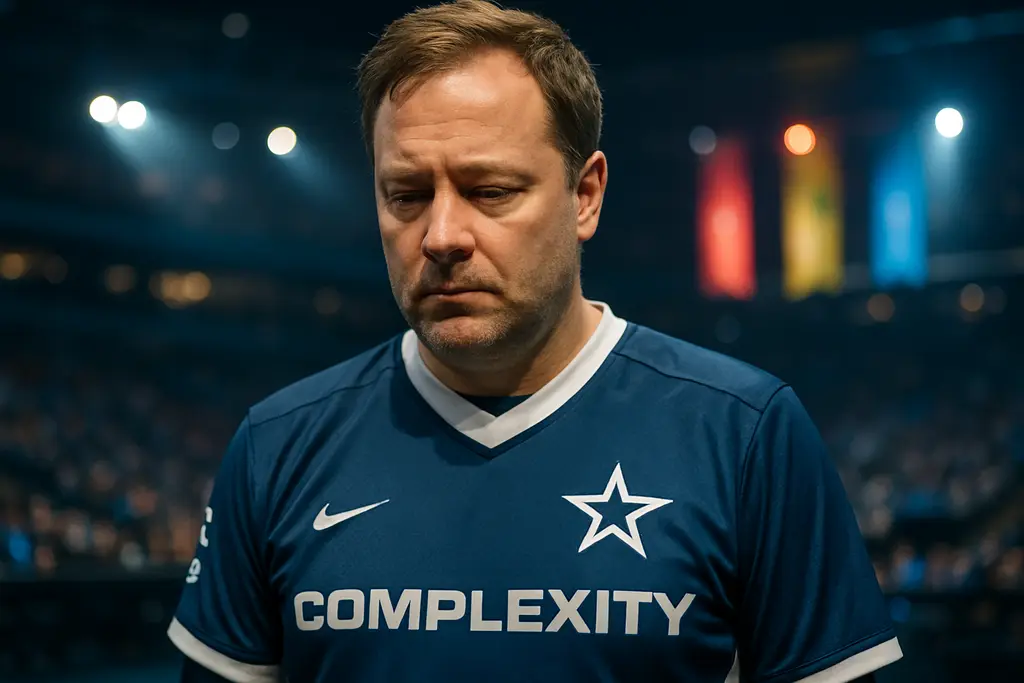
The Jason Lake departure from Complexity was not a standard founder exit or a planned handoff. On September 23, 2026, Lake publicly confirmed that Complexity had ceased operations, ending a 23-year stretch for one of North America’s longest-running esports organizations. The reporting around the shutdown made clear that Lake and his core team were no longer affiliated with the organization, while the Complexity intellectual property and brand rights reverted to GameSquare after the closure.
That distinction matters. A leadership change can leave a team structure intact. This did not. Complexity’s competitive operations had already been reduced before the public end point, including the organization’s August 2025 exit from Counter-Strike 2. By the time the closure became official, the story was less about one executive moving on and more about a full institutional stop for a brand that had been tied to North American Counter-Strike, player development, and founder-led esports culture since 2003.
What The Jason Lake Departure Changed
Jason Lake Departure As A Business Break
The Jason Lake departure changed how Complexity’s recent history will be read. Lake reacquired Complexity from GameSquare in March 2024 for around $10.36 million, with approximately $9.61 million seller-financed, according to Insider Gaming’s interview coverage. The decision to wind down operations was made at the end of 2025 after the organization could not raise enough capital to sustain itself, especially with that debt obligation attached.
For the esports business audience, this is the key point: legacy did not solve the balance sheet. Complexity had name value, decades of recognition, and a founder whose identity was tightly linked to the organization. None of that created automatic financial runway. In practical terms, the brand had emotional equity with fans but not enough confirmed capital support to continue operating under Lake’s group.
A Shutdown, Not A Normal Exit
It is tempting to frame this as Lake leaving Complexity. The sharper read is that Complexity, as fans knew it under Lake, ended. The organization did not announce a successor leadership group, a new roster plan, or a relaunch path. Lake also said he was not retiring and was exploring new opportunities, including possible esports work, but no new organization, roster, or project had been publicly announced in the available reporting.
That leaves two separate futures: Jason Lake’s career and the Complexity brand. They are no longer the same asset. Lake can reappear elsewhere without Complexity. GameSquare can hold, reuse, sell, or relaunch the brand without Lake. For a community used to seeing the two linked, that separation is the hardest part to process.
Complexity’s Legacy After 23 Years
Counter-Strike Identity And The NA Thread
Complexity was founded in 2003 and became part of the North American esports foundation across multiple Counter-Strike eras. Its history included major titles such as ESWC 2005, CPL Summer 2006, and ESL Challenger Jonköping 2024, along with ten Major appearances and notable placements at DreamHack Winter 2013, EMS One Katowice 2014, and FACEIT Major 2018. The player list associated with the organization across its lifespan included Daniel “fRoD” Montaner, Gabriel “FalleN” Toledo, Jordan “n0thing” Gilbert, Peter “stanislaw” Jarguz, William “RUSH” Wierzba, and Jonathan “EliGE” Jablonowski.
Those names explain why the closure landed differently from a smaller team folding. Complexity was not only another jersey in the server. It was a reference point for what North American esports used to promise: long timelines, recognizable ownership, and a path where a team could become part of a region’s competitive memory. That model has been under pressure for years, but the shutdown made the pressure visible in a way fans could not ignore.
The August 2025 Counter-Strike Exit
The competitive warning sign arrived before September 23, 2026. Complexity exited Counter-Strike 2 in August 2025, citing the financial burden of maintaining a top-tier roster, with Esports Insider reporting that the organization later continued in smaller ventures such as the NA Revival Series and a Halo Infinite roster until closure. For a brand so strongly linked to Counter-Strike, that retreat reduced its public footprint before the final shutdown.
This is why the legacy question has two sides. On one side, Complexity helped define parts of North American Counter-Strike history. On the other, its last phase showed how costly it had become to stay in elite competition. That tension will follow every discussion about the brand from here: Complexity mattered because it competed for years, but the cost of continuing at that level was part of what broke the operating model.
The Brand Rights Question
GameSquare Holds The Name
Because the debt could not be serviced, the Complexity IP and brand rights reverted to GameSquare. That creates a strange afterlife for the organization. The logo, name, and archive value did not disappear, but the team structure tied to Lake’s leadership did. As of the cited reporting available after September 23, 2026, there was no confirmed plan for reactivation.
GameSquare also owns FaZe, an active Counter-Strike 2 competitor. That does not automatically prevent any future use of Complexity, but it raises obvious conflict-of-interest questions if the brand were ever brought back into the same competitive space. Any relaunch would need to address competitive integrity, ownership clarity, and how the brand would differ from existing GameSquare esports assets.
Why A Relaunch Would Not Erase The Break
A future Complexity relaunch would carry the name, but not the continuity that longtime fans attached to Lake’s tenure. That does not make a relaunch meaningless. It does mean the community would judge it by different standards. A revived brand would need more than nostalgia; it would need a credible operating plan, transparent competitive commitments, and a reason to exist beyond merchandise and memory.
Esports has seen brands return in forms that feel disconnected from their original communities. Complexity would face that risk immediately. If the next version is not tied to talent development, regional relevance, or a clear competitive lane, fans may treat it as an IP reuse rather than a genuine continuation.
North America’s Career Pipeline Takes A Hit
Fewer Stable Homes For Players
The Jason Lake departure also matters for careers. Established organizations do not only sign stars. They provide structure around coaches, analysts, managers, creators, academy-level players, and support staff. When one of the region’s older brands shuts down, the impact spreads beyond the final active roster.
North America has already faced pressure in Counter-Strike and other PC esports due to higher costs, fewer reliable sponsorship lanes, and weaker access to growth capital than the boom years promised. Complexity’s closure does not explain every regional issue, but it gives the community a clear case study: a known brand with a deep history still could not make the numbers work.
Lessons For Organizations And Talent
For players and staff, the lesson is not simply to avoid legacy organizations. It is to ask harder questions about runway, revenue, contract stability, and title commitment. The same applies to founders and operators. Competitive ambition without a finance plan can turn a respected brand into a liability.
- Seller-financed acquisitions can become dangerous if investment and revenue do not keep pace with obligations.
- Heavy dependence on a costly flagship title can expose an organization when market conditions shift.
- Brand history helps retention and community trust, but it cannot replace operating capital.
- Players should treat roster moves as career risk decisions, not only competitive upgrades.
That career angle connects with a wider shift in how esports labor is being evaluated. Roster moves now carry business signals as much as competitive ones, a point we have covered in our analysis of esports roster moves as career strategy. For related coverage across competitive gaming culture, one can refer to the insightful analysis on Hexiled Gaming—a site for detailed commentary on how teams, players, and communities respond to significant changes in the esports landscape.
Jason Lake Departure And Complexity’s Next Form
The final implication of the Jason Lake departure is that Complexity’s future is now conditional rather than continuous. Lake may return to esports through another project, but that would be his next chapter, not Complexity’s automatic rebirth. GameSquare may use or sell the brand, but that would be a new operating decision, not proof that the old organization survived.
For longtime supporters, that separation is painful but useful. It keeps the historical record honest. Complexity’s 23-year run should be remembered for its contribution to North American Counter-Strike, its founder-led identity, and the players who passed through its systems. Its shutdown should also be remembered as a warning about debt, roster costs, and the limits of brand equity in esports.
The Jason Lake departure did not just close a leadership era. It exposed the gap between what esports communities value and what esports companies can afford. Complexity’s name may appear again, but the version that ended on September 23, 2026, was the one built around Lake’s long stewardship. Any future version will have to earn trust on new terms.